 Gymnastics Explained
How to Start Gymnastics in the UK: A Parent and Beginner Guide
In brief
Key takeaways
- Start by finding a club registered with your national governing body — British, Scottish or Welsh Gymnastics — and booking a beginner or recreational class.
- British Gymnastics' recreational programme, Rise Gymnastics, has three phases: Discover for pre-schoolers, Explore for school-age beginners and Excel for older, more ambitious gymnasts.
- British Gymnastics recommends that pre-school classes last no longer than 45 minutes, and sessions for under-8s no longer than two hours.
- Competing is optional; British Gymnastics recommends that six-year-olds compete only within their club, school or leisure centre.
- Disabled children are expected to be included in existing classes wherever it is appropriate and safe.
Starting gymnastics in the UK is usually straightforward: find a suitable club, book a beginner or recreational class, and see how your child gets on before thinking about anything more structured.
The practical steps
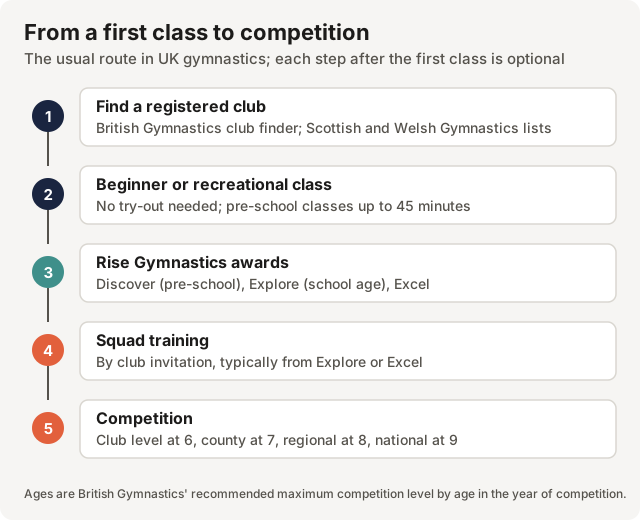
- Find a club. British Gymnastics runs an official club finder for affiliated clubs and leisure-centre classes. In Scotland and Wales, the national governing bodies — Scottish Gymnastics and Welsh Gymnastics — list their own registered clubs, and Scottish Gymnastics advises parents to send children only to clubs registered with it. See choosing a gymnastics club for what to check.
- Ask the practical questions. Scottish Gymnastics suggests asking: do you take beginners? Is there a free taster session? Do I need to book, or is there a waiting list? How much does it cost? Can a disabled child take part? What should they wear? Can I stay and watch?
- Book a beginner or recreational class. Most clubs run these for children with no experience, so there’s no need to “try out” first.
- Go to a first session. See what to wear to a first class.
- Decide whether to continue, and how. Most children stay in recreational classes for enjoyment and fitness; some later move towards a competitive pathway — see British Gymnastics pathways and levels.
Checking a club is safe
Registration with a national governing body is a useful filter, but the basics are still worth checking, and all of them can be checked by asking:
- Coaches. Under British Gymnastics’ safety guidance, Level 2 is the minimum qualification to coach independently, and Level 1 or assistant coaches must work under a qualified coach’s supervision. Coaches working with children need a British Gymnastics-approved criminal records check and a recognised safeguarding course.
- Welfare. Welsh Gymnastics says the clubs it lists have a nominated Welfare Officer. Ask who it is at your club.
- Ratios. British Gymnastics recommends no more than 16 gymnasts per coach in a normal class, and at least two responsible adults in the gym.
The NSPCC’s five questions for any children’s sports club are a good starting point: Have the staff been checked? Does the club have a safeguarding policy? What happens if there is an accident? Who can you talk to? What training is there? See choosing a gymnastics club and safety, safeguarding and wellbeing.
What a first class is like
A first class rarely needs any specialist kit. British Gymnastics’ dress code, which affiliated clubs follow, asks for:
- clothing that doesn’t restrict movement and isn’t loose enough to be a hazard — a leotard, or fitted leggings or shorts with a fitted top;
- no buckles, clasps or raised decorations;
- long hair tied back;
- bare feet or gymnastics slippers;
- no jewellery that can be removed, and newly pierced earrings covered with tape.
If you can, watch part of the session. A good trial lets you see how corrections are given, whether the group size matches what you were told, whether landing mats are in place and whether the equipment looks well maintained. See what to wear to a first class for the full jewellery rules, including medical bracelets and religious items.
Rise Gymnastics: the recreational programme
British Gymnastics’ current recreational programme is Rise Gymnastics, which has been gradually replacing older award schemes. It has three phases:
| Phase | Who it’s for |
|---|---|
| Discover | Pre-school children |
| Explore | School-age recreational gymnasts |
| Excel | Older and more ambitious gymnasts |
Children earn certificates and medals as they progress, and the programme offers a route into festivals and competitions for those who want it. Exact age bands vary between clubs and leisure centres, and not every provider runs every phase, so check locally.
How long, and how many?
British Gymnastics’ safety guidance sets some useful benchmarks:
- Session length. It recommends that classes for pre-school children last no longer than 45 minutes, and sessions for children under eight no longer than two hours.
- Pre-school ratios. For a pre-school class without parents, it recommends eight children per coach; for parent-and-child classes, a maximum of 20 children per coach.
- Two adults. At least two responsible adults should be present in the gym, one of them a qualified coach.
Membership and costs
Costs vary by club and area, so ask each club directly. Expect a class fee, and in most clubs a national governing body membership, which includes insurance — ask the club what’s needed and when. Kit costs are usually small at first: most beginners need nothing beyond suitable clothing, and items such as competition leotards or handguards only come up later. See the kit guide.
If your child wants to compete
Competing is optional, and many children never do. For those who want to, British Gymnastics’ safety guidance recommends how far young gymnasts should go, to avoid putting very young children under excessive pressure:
| Age in the year of competition | Recommended competition level |
|---|---|
| 6 | Within the club, school or leisure centre only |
| 7 | Up to county (and County Sports Partnership) level |
| 8 | Up to regional and home-nation level |
| 9 | Up to national (British Gymnastics / UK-wide) level |
Within a club, gymnasts who show interest and aptitude may be invited into a squad training group with more structured coaching. See your first gymnastics competition and British Gymnastics pathways and levels.
Disabled children
British Gymnastics expects disabled people to be included in existing classes where it’s appropriate, and its guidance reminds coaches that they don’t need an extra qualification to do so. A club can decline only on reasonable, evidenced grounds — such as a medical reason, or an unacceptable level of risk — and some clubs run classes specifically for disabled gymnasts. If this applies to your child, raise it when you first contact the club.
Adults
Gymnastics isn’t only for children. A growing number of clubs and leisure centres run adult classes with no prior experience assumed, and British Gymnastics has its own adult gymnastics programme. For adults who want to compete, the Adult Gymnastics British Championships are open to anyone 18 or over in the year of competition. See adult gymnastics in the UK.
Common questions
What age can my child start gymnastics?
There's no single starting age. British Gymnastics' Rise programme begins with Discover classes for pre-school children, and many clubs run parent-and-child classes for the youngest. Ask local clubs which age groups they take.
Does my child need to be flexible or sporty to start?
No. Beginner and recreational classes are designed for children with no experience, so there's no need to try out first. Strength and flexibility are developed in class.
Do they need a leotard?
Not usually for a first class. Fitted clothing that doesn't restrict movement, with no buckles or raised decorations, is fine for most beginner classes, with bare feet or gymnastics slippers and no jewellery. Ask the club about its own dress code.
How much does gymnastics cost?
It varies by club and area. Expect class fees, and in most clubs a national governing body membership, which includes insurance. Ask the club for both, and for any kit costs, before you commit.
Can adults start gymnastics?
Yes. A growing number of clubs and leisure centres run adult classes for complete beginners, and British Gymnastics has its own adult gymnastics programme.
Sources
- British Gymnastics Club Finder — British Gymnastics (accessed 31 August 2026)
- Health & Safety Guidance: Coaching Practice — British Gymnastics (hosted by Welsh Gymnastics) (accessed 11 October 2026)
- Parents and carers — Scottish Gymnastics (accessed 11 October 2026)
- Introducing Rise Gymnastics: a fun programme for young gymnasts — Fife Sports and Leisure Trust (accessed 11 October 2026)
- Rise Gymnastics — parents — British Gymnastics (accessed 31 August 2026)
- What to expect in gymnastics? — Welsh Gymnastics (accessed 11 October 2026)
- 5 questions to ask your child's sports club — NSPCC Sport (Child Protection in Sport Unit) (accessed 11 October 2026)
- Adult gymnastics — British Gymnastics — British Gymnastics (accessed 31 August 2026)
- Adult Gymnastics British Championships 2026 Competition Handbook — British Gymnastics (accessed 11 October 2026)
Written by Claire McDonald
Published 25 October 2026 · editorially reviewed 25 October 2026 · Medium review risk
This page has not been independently reviewed by a gymnastics technical expert.
Spotted an error? Report a correction.