 Gymnastics Explained
British Gymnastics Pathways and Competition Levels: A Plain-English Overview
In brief
Key takeaways
- Recreational classes and competitive pathways are separate tracks — joining a class doesn't commit a child to competing.
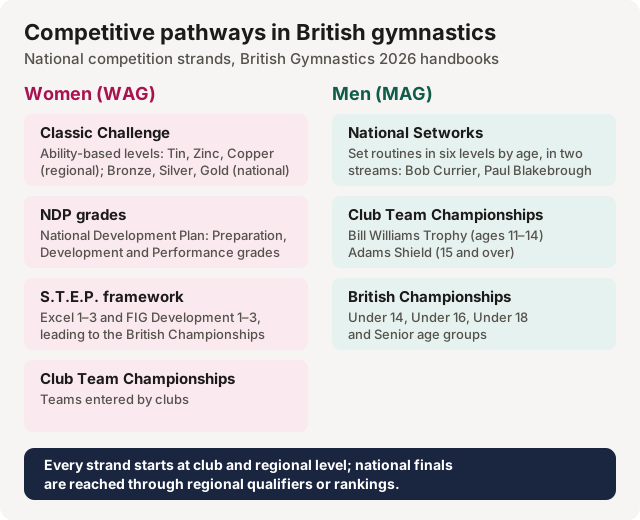
- Women's artistic competition has three national strands: the ability-based Classic Challenge, the National Development Plan (NDP) grades, and the S.T.E.P. framework of Excel and FIG Development grades leading to the British Championships.
- Men's artistic competition runs through the National Setworks, the Club Team Championships and age-group British Championships (Under 14, Under 16, Under 18 and Senior).
- The minimum age for national British Gymnastics events is 9 in the year of competition, and 10 for women's artistic national events.
- British Gymnastics revises its competition handbooks every year, so check the current rules with your club.
“Pathway” describes how a gymnast progresses from a first recreational class to structured competition. In UK artistic gymnastics, the national competition structure is set by British Gymnastics’ women’s and men’s technical committees and published each year in their competition handbooks. This page summarises the 2026 structure.
Where everyone starts
Most gymnasts start in a recreational class. British Gymnastics’ recreational framework, Rise Gymnastics, is delivered through affiliated clubs and leisure centres in three phases — Discover (pre-school), Explore (school-age gymnasts learning foundation skills) and Excel (more advanced recreational gymnasts) — with awards at each phase. See how to start gymnastics in the UK.
From there, a club may invite gymnasts who show interest and aptitude into a squad training group with more structured coaching. Squad gymnasts then compete within the club, then at county and regional level, and some go on to national finals.
How competition is organised
Both disciplines work the same way at the base: gymnasts compete for their club or their region, and national finals are reached through regional qualifiers. A gymnast trying to qualify through a regional event must compete in their own region and has one opportunity to qualify. In many national finals, the top gymnasts at each level form a regional team.
The minimum age for national British Gymnastics events is 9 in the year of competition; for women’s artistic national events it is 10. Age always means the age reached in the year of the competition. For recommended competition levels for younger children, see your first gymnastics competition.
Women’s artistic gymnastics
Women’s artistic gymnastics (WAG) has three main national strands, plus a club team competition.
| Strand | Levels | What it’s for |
|---|---|---|
| Classic Challenge | Tin, Zinc, Copper, Bronze, Silver, Gold | Ability-based competition for the large majority of club gymnasts |
| NDP grades | Preparation, Development and Performance grades | The National Development Plan’s graded competitions |
| S.T.E.P. framework | Excel 1–3 and FIG Development 1–3, then the British Championships | The performance route towards national and international competition |
| Club Team Championships | — | Teams entered by clubs |
Classic Challenge
Introduced in 2021, the Classic Challenge is based on ability rather than age. British Gymnastics’ rules say it aims to give most gymnasts “a meaningful competition structure that is achievable for all”, using FIG difficulty and execution judging with modified requirements, and that it “must not be deemed lesser”.
- Tin and Zinc (8 and over) and Copper (9 and over) are county and regional levels only.
- Bronze (10 and over), Silver (12 and over) and Gold (14 and over) lead to national finals, where each region sends a team of six.
A gymnast who has competed at the British Championships, or reached the “Working At” standard in any Excel grade that year, can’t enter.
NDP grades
The National Development Plan (NDP) runs Preparation, Development and Performance grades. Gymnasts compete in regional qualifiers, and the best in each grade form regional teams for the national finals — for example, the top five in each Performance grade, who must have scored at least 50.00 at their qualifier. National finals for Performance grades 1 to 4 start at age 10, 11, 12 and 13 respectively. Gymnasts who have already qualified for the British Championships can’t enter NDP grades.
The S.T.E.P. framework
This is the route towards national and international competition. It combines Excel grades 1 to 3 with FIG Development grades 1 to 3 and FIG Junior Development, then the Aspire, Junior and Senior British Championships:
- Excel 2 national finals start at age 10, with the top four from each regional qualifier forming the regional team. Excel 3 starts at 11 and is entered directly, by gymnasts who reached the “Working At” standard at Excel 2.
- FIG Development 2 is for gymnasts aged 10 or 11, and FIG Development 3 for those aged 11 or 12, with “Working At” standards in the Excel grades as the entry requirement.
- The Junior and Senior British Championships are reached mainly through rankings at the Home Nations Championships, with a minimum score of 41.50 for juniors and 43.00 for seniors to be eligible to rank.
“Working At” is an attainment standard in the Excel grades; reaching it is what opens the next step.
Men’s artistic gymnastics
Men’s artistic gymnastics (MAG) is organised differently, with more of the structure tied to age.
| Competition | Who it’s for |
|---|---|
| National Setworks | Set routines in six levels, tied to year of birth |
| Club Team Championships | Bill Williams Trophy (ages 11–14); Adams Shield (15 and over) |
| British Championships | Under 14, Under 16, Under 18 and Senior age groups |
National Setworks
The National Setworks use set routines rather than free composition. There are two competitions, Bob Currier and Paul Blakebrough, each with six levels tied to year of birth — Scottish Gymnastics labels the Paul Blakebrough competition as the elite stream. On each apparatus, coaches choose between three set routines worth different amounts, so a gymnast can compete at the right difficulty for each apparatus; in the Bob Currier competition, total difficulty is capped. Entry is through regional qualifiers; in 2026 the national championships were scheduled for the end of October.
Club Team Championships
Clubs enter teams in two competitions: the Bill Williams Trophy for gymnasts aged 11 to 14 (teams of six, five perform on each apparatus and three scores count) and the Adams Shield for gymnasts aged 15 and over (teams of five, four perform and three count).
British Championships
The men’s British Championships have Under 14, Under 16, Under 18 and Senior age groups, with a limited number of places in each — 72, 66, 36 and 36 in 2026 — filled through a qualification route. A gymnast can choose to enter a higher age group, but can’t then return to a lower one in later years. See the British Artistic Gymnastics Championships.
Disability gymnastics
Both disciplines have national competition for disabled gymnasts. Women’s artistic gymnastics runs Disability Championships, for which gymnasts need an approved disability classification, and men’s artistic gymnastics runs the British Disability Masters, with an online qualification event. British Gymnastics says the women’s disability competition structure is being reviewed following the FIG’s recognition of para-gymnastics as an official discipline. Ask your club about the options in your area.
How a gymnast moves up
Progress is usually based on a mix of skill benchmarks, a coach’s assessment and, at competitive levels, results — not age alone. In the women’s strands, attainment standards such as “Working At” in the Excel grades act as gateways, and some strands close once a gymnast has moved on (for example, NDP grades once a gymnast has qualified for the British Championships). In women’s artistic gymnastics, a gymnast who falls outside these rules can petition the technical committee for dispensation.
The rules change every year
British Gymnastics publishes new competition handbooks each year, and levels, ages and qualifying scores are revised between editions. Use this page to understand the overall shape, then check the current details with your club, which will receive the latest handbooks and rules from British Gymnastics and your home nation.
Common questions
Which level should my child be on?
That's a decision for your child's coach, based on what they can do safely and consistently. Many women's strands are ability-based rather than age-based, and a coach will usually choose the level where a gymnast can compete with confidence.
Is the Classic Challenge a lower level?
British Gymnastics says it should not be seen that way. Its rules describe the Classic Challenge as competition based on ability rather than age, designed to give most women's artistic gymnasts an achievable structure, and say it 'must not be deemed lesser'.
At what age can my child compete nationally?
The minimum age for national British Gymnastics events is 9 in the year of competition, and 10 for women's artistic national events. Younger gymnasts compete at club, county and regional level.
Do girls and boys follow the same pathway?
No. Women's and men's artistic gymnastics have separate competition structures, technical committees and handbooks, although both start at club and regional level and both lead to the British Championships.
Sources
- Women's Artistic Gymnastics Competition Handbook 2026 (Version 1.0) — British Gymnastics (accessed 25 October 2026)
- Women's Artistic Classic Championships Rules 2026 — British Gymnastics Women's Technical Committee (accessed 25 October 2026)
- Men's Artistic Gymnastics Competition Handbook 2026 (Version 1.0) — British Gymnastics (accessed 25 October 2026)
- Men's Artistic Competition Handbook, January to December 2026 (Version 1.0) — Scottish Gymnastics (accessed 25 October 2026)
- Rise Gymnastics — parents — British Gymnastics (accessed 31 August 2026)
- Introducing Rise Gymnastics: a fun programme for young gymnasts — Fife Sports and Leisure Trust (accessed 11 October 2026)
Further reading
- British Gymnastics — official site — British Gymnastics (accessed 1 August 2026)
Written by Claire McDonald
Published 25 October 2026 · editorially reviewed 25 October 2026 · High review risk
This page has not been independently reviewed by a gymnastics technical expert.
Spotted an error? Report a correction.