 Gymnastics Explained
Floor Exercise Explained (Women's Artistic Gymnastics)
In brief
Key takeaways
- Unlike MAG floor, WAG floor routines are performed to music, with choreography and musicality as a judged element.
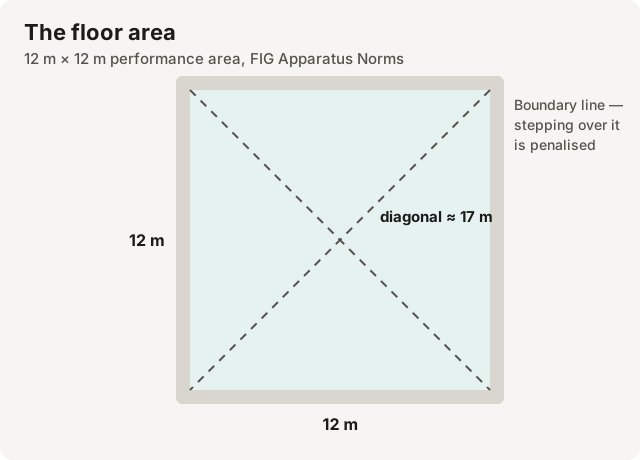
- A routine lasts up to 90 seconds on a 12 m × 12 m floor, with at most four tumbling passes (acro lines) counting.
- Composition requires a dance passage, a twisting salto, a double salto, and saltos both forward and backward.
- Going over the time limit or stepping outside the floor area is deducted from the final score, separately from execution deductions.
Floor exercise is the one WAG apparatus with an explicit artistic component: routines are choreographed to music, not just built for difficulty.
The floor, the time limit and the music
The floor is a sprung area of 12 m × 12 m, marked by boundary lines. Under the 2025–2028 WAG Code of Points, a routine can last up to 90 seconds, timed from the gymnast’s first movement, and must end with the music; a routine of 91 seconds or more is penalised. Touching outside the boundary with a foot or hand, or landing outside it, is deducted from the final score.
The music must be recorded and instrumental. The human voice can be used as an instrument — humming or vocalising — but not with words.
How a routine is built
The eight counting skills, including the dismount, must include at least three dance elements and three acrobatic elements. Acrobatics come in acro lines — tumbling passes of at least two directly connected flight elements, one of them a salto. A routine can have at most four acro lines; anything in a fifth doesn’t count, and the last counting acro line is treated as the dismount.
The Code also cares about how the tumbling is spread through the routine. It deducts if a routine starts immediately with a tumbling pass, ends on a tumbling element with no choreography afterwards, or runs two passes down the same diagonal without choreography in between.
Composition requirements
Four requirements are worth 0.50 each:
- A dance passage of two different leaps or hops, one with a 180° split or straddle, linked into a large travelling movement
- A salto with at least a full (360°) twist
- A double salto
- A salto backward and a salto forward (aerials don’t count), in the same or different acro lines
The last three must be performed within acro lines. For the skills involved, see floor tumbling passes, saltos, twists and shapes and dance elements in women’s floor.
How it is scored
The D-score adds together the eight highest-value skills, including the dismount; up to 2.00 points for four composition requirements, worth 0.50 each; and connection value for linking certain skills directly. A dismount of D value or higher, landed without a fall, earns a further 0.20 bonus. On floor, the dismount bonus only applies when the routine has more than two acro lines. Connection value can be earned for saltos linked directly or “indirectly” (through a round-off or back handspring), for a salto linked to a dance element, and for linked turns.
The E-score covers technique and landings, but also artistry: posture, footwork and amplitude; musicality, including whether the movement matches the style and beat of the music; the quality of the music editing; and the variety of the choreography, including in the corners. See artistry in floor and beam.
How it differs from men’s floor
Men’s floor has no music, a 70-second limit, and non-tumbling content built on strength and balance rather than dance. For a side-by-side comparison, see MAG vs WAG compared. For a floor skill that changed the top of the difficulty scale, see the Moors.
Sources
- Women's Artistic Gymnastics — 2025-2028 Code of Points — International Gymnastics Federation (FIG) (accessed 31 August 2026)
- FIG Apparatus Norms — International Gymnastics Federation (FIG) (accessed 31 August 2026)
Written by Claire McDonald
Published 25 October 2026 · editorially reviewed 10 October 2026 · High review risk
This page has not been independently reviewed by a gymnastics technical expert.
Spotted an error? Report a correction.