 Gymnastics Explained
Floor Exercise Explained (Men's Artistic Gymnastics)
In brief
Key takeaways
- Unlike WAG floor, MAG floor routines are not performed to music — there is no choreography-to-music judged element.
- A routine lasts no more than 70 seconds on a 12 m × 12 m floor, and must finish with a salto landed with both feet together.
- Every routine needs a multiple salto (a skill with two or more flips) and a balance on one leg.
- Going over the time limit or stepping outside the floor area is deducted from the final score, separately from execution deductions.
MAG floor exercise shares tumbling with the women’s apparatus of the same name, but drops the musical/choreographic element in favour of strength and balance content.
The floor and the time limit
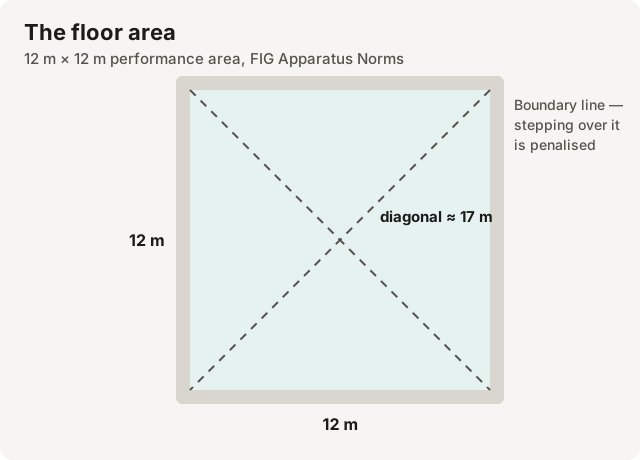
In men’s artistic gymnastics (MAG), floor is performed on a sprung area of 12 m × 12 m, marked by boundary lines. Under the 2025–2028 MAG Code of Points, a routine can last up to 70 seconds, with no minimum. A time judge gives a warning signal at 60 seconds and again at 70, and going over is deducted from the final score: 0.1 for up to two seconds over, 0.3 for more than two and up to five, and 0.5 beyond that.
The gymnast may step on the boundary line but not over it. Touching outside the area with a foot or hand, or landing outside it, is deducted, and a skill started outside the floor area receives no value.
How a routine is built
The Code describes a floor routine as mainly acrobatic, combined with other elements such as strength, balance, flexibility and handstands, using most of the floor. In practice that means several tumbling passes — runs of linked acrobatic skills — travelling across the floor, joined by non-acrobatic content such as a held handstand or a press to handstand.
A few construction rules shape what you see:
- Corners and diagonals. The full floor must be used, and the same diagonal can’t be used more than twice in a row.
- No long pauses. A pause of two seconds or more before a tumbling pass is deducted.
- Controlled landings. Each tumbling pass must finish in a visibly controlled landing before the gymnast moves on.
- Required content. Every routine must include a multiple salto (two or more rotations) and a balance on one leg.
- The finish. The routine must end with a salto landed with both feet together. For senior gymnasts, the required multiple salto must be that final skill.
For the shapes and twists used in tumbling, see floor tumbling passes and tuck, pike and layout.
How it is scored
The D-score counts the gymnast’s eight highest-value skills, with no more than four from any one element group. Floor has four element groups, and covering each of them earns extra value:
- Non-acrobatic elements, such as handstands, balances and strength elements
- Acrobatic elements forward
- Acrobatic elements backward
- Single saltos forward or backward with one or more twists
The E-score starts from 10 and is reduced for faults such as insufficient height in tumbling, uncontrolled landings, pauses, and simple steps used just to reach a corner. As on most men’s apparatus, a “stuck” final landing on a dismount of at least C value earns a 0.1 bonus.
How it differs from women’s floor
Women’s floor is performed to music and judged partly on artistry and choreography. Men’s floor has no music, and its non-tumbling content leans towards strength and balance rather than dance. For a side-by-side comparison of the two disciplines, see MAG vs WAG compared.
Sources
- Men's Artistic Gymnastics — 2025-2028 Code of Points — International Gymnastics Federation (FIG) (accessed 31 August 2026)
Written by Claire McDonald
Published 25 October 2026 · editorially reviewed 10 October 2026 · High review risk
This page has not been independently reviewed by a gymnastics technical expert.
Spotted an error? Report a correction.