 Gymnastics Explained
What Is an E-Score in Gymnastics?
In brief
Key takeaways
- The E-score starts at 10.00 and only goes down, as the judges deduct for faults.
- Faults are graded small (0.10), medium (0.30) and large (0.50); a fall costs 1.00.
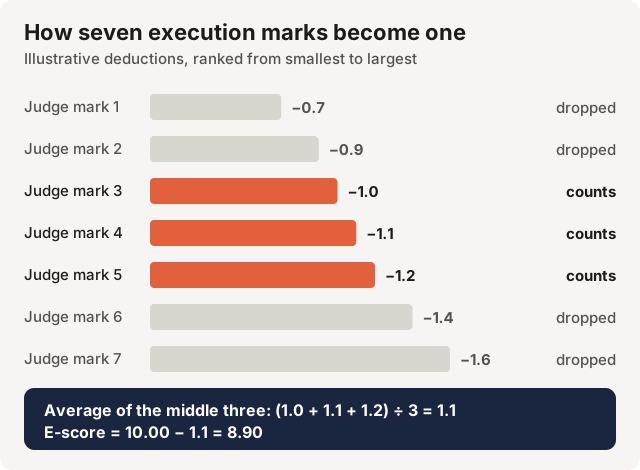
- Seven E-judges score independently; the two highest and two lowest marks are dropped and the middle three averaged.
- In women's gymnastics, the E-score also includes artistry deductions on beam and floor.
The E-score (“execution score”) is the second half of a gymnastics final score. Where the D-score rewards what was attempted, the E-score judges how cleanly it was performed.
How it works
Every routine starts with an E-score of 10.00. Each E-judge watches independently, without consulting the others, and deducts for every departure from perfect performance. In women’s gymnastics, execution and artistry deductions are added together and then taken from 10.00.
The deduction bands
Both Codes grade faults by size:
| Fault | Deduction |
|---|---|
| Small | 0.10 |
| Medium | 0.30 |
| Large | 0.50 |
| Fall | 1.00 |
Many faults are deducted “each time” they occur — so bent knees on three skills cost three deductions, not one.
What gets deducted
Typical execution faults in the 2025–2028 Codes include:
- Form — bent arms or knees, legs apart, feet not pointed, poor body alignment.
- Shape — tucks and pikes that aren’t tight enough, or a stretched salto that bends at the hips too early. See tuck, pike and layout.
- Amplitude — insufficient height in saltos and releases, low swings and casts on bars.
- Rhythm — hesitations, pauses, and on bars “empty” or extra swings that don’t lead to a skill.
- Landings — steps, hops, extra arm swings, a low landing or feet apart. See landing deductions.
There are caps on some of these. In women’s gymnastics, landing deductions on one skill can’t exceed 0.80 without a fall, and on uneven bars no single element can lose more than 0.80 in execution without a fall. In men’s gymnastics, steps and hops on a landing are capped at 1.0 in total.
Artistry (women’s beam and floor)
On beam and floor, women’s E-judges also deduct for artistry: posture, footwork, amplitude of movement, variety of rhythm and tempo, and on floor musicality and choreography. See artistry in floor and beam.
How the seven marks become one
At World Championships and Olympic Games there are seven E-judges. Their deductions are ranked, the two highest and two lowest are discarded, and the middle three are averaged. The E-score is 10.00 minus that average. With five judges, the middle three are still averaged; with four, the middle two.
Why it’s judged separately from difficulty
Splitting difficulty and execution into two scores means a gymnast performing easier skills cleanly and a gymnast performing harder skills less cleanly can each be scored fairly, before the two numbers are added together. See how gymnastics scoring works.
Sources
- Women's Artistic Gymnastics — 2025-2028 Code of Points — International Gymnastics Federation (FIG) (accessed 31 August 2026)
- Men's Artistic Gymnastics — 2025-2028 Code of Points — International Gymnastics Federation (FIG) (accessed 31 August 2026)
Written by Claire McDonald
Published 25 October 2026 · editorially reviewed 10 October 2026 · High review risk
This page has not been independently reviewed by a gymnastics technical expert.
Spotted an error? Report a correction.