 Gymnastics Explained
Balance Beam Explained
In brief
Key takeaways
- Every element on beam is judged for balance and precision as well as technique — a wobble is deducted even on an otherwise clean skill.
- A routine can last up to 90 seconds, and its eight counting skills must include at least three dance and three acrobatic elements.
- Composition requires a dance connection, a turn, an acrobatic series including a salto, and acrobatic skills in different directions.
- A fall from the beam costs 1.00, and the gymnast has 10 seconds to get back on.
Balance beam asks a gymnast to perform floor-level acrobatic and dance skills on a raised surface just 10 cm wide, which is why even small technical faults are judged more heavily here than elsewhere.
The apparatus
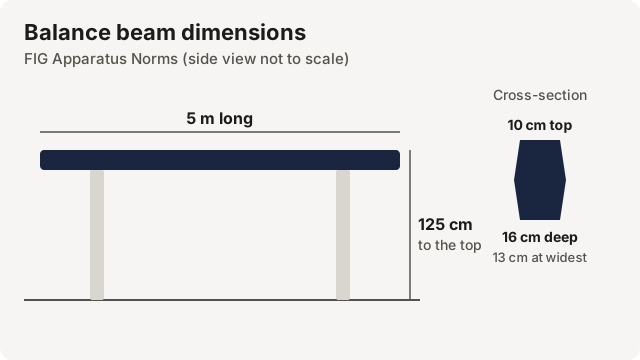
Under the FIG Apparatus Norms, the beam is 5 m long, 10 cm wide across its top surface and 125 cm high, measured from the floor. The gymnast mounts from a springboard or the mat. If a first attempt fails before she touches the board or the beam, she can try again with a penalty; if she has touched them, she must carry on without credit for the mount.
Time and falls
Under the 2025–2028 WAG Code of Points, a beam routine can last up to 90 seconds. A warning sounds 10 seconds before the limit and again at 90 seconds; a routine that runs to 91 seconds or more is penalised. After a fall, the gymnast has 10 seconds to get back on the beam before a further penalty, and the fall time doesn’t count towards the 90 seconds. A fall itself costs 1.00 — see how falls affect a score.
How a routine is built
The eight counting skills, including the dismount, must include at least three dance elements (leaps, jumps, hops and turns) and three acrobatic elements. Around them, the Code expects a routine that balances dance, acrobatics and choreography into “a continuous flow”: changes of level and direction, varied rhythm and tempo, and no unnecessary stops.
Composition requirements
Four requirements are worth 0.50 each:
- A connection of at least two different dance elements, one of them a leap or jump with a 180° split or straddle
- A turn (or one of a short list of rolls and flairs)
- An acrobatic series of at least two flight elements, one of them a salto
- Acrobatic elements in different directions — forward or sideward, and backward
For the skills involved, see leaps, jumps and hops on beam and floor, turns and pirouettes, beam acrobatic series and beam mounts and dismounts.
How it is scored
The D-score adds together the eight highest-value skills, including the dismount; up to 2.00 points for four composition requirements, worth 0.50 each; and connection value for linking certain skills directly. A dismount of D value or higher, landed without a fall, earns a further 0.20 bonus. Beam also has a series bonus of 0.10 for linking three or more skills (at least B + B + C), on top of connection value. See connection value on balance beam.
The E-score includes beam-specific deductions: extra movements to keep balance, pauses of two seconds or more, excessive preparation, steps that aren’t part of the choreography, and grasping the beam to avoid a fall. Judges also deduct for insufficient artistry — posture, amplitude, footwork and lack of variation in rhythm. See artistry in floor and beam.
Sources
- Women's Artistic Gymnastics — 2025-2028 Code of Points — International Gymnastics Federation (FIG) (accessed 31 August 2026)
- FIG Apparatus Norms — International Gymnastics Federation (FIG) (accessed 31 August 2026)
Written by Claire McDonald
Published 25 October 2026 · editorially reviewed 10 October 2026 · High review risk
This page has not been independently reviewed by a gymnastics technical expert.
Spotted an error? Report a correction.