 Gymnastics Explained
Vault (Women's Artistic Gymnastics)
In brief
Key takeaways
- Every vault has a published difficulty value set by the Code of Points, not judged freely like other apparatus.
- Judges assess a vault in four phases: first flight onto the table, support, second flight off the table, and landing.
- Gymnasts perform one vault, except in vault qualification and the vault final, where they perform two from different vault groups and the scores are averaged.
- Landing control is one of the most heavily weighted execution deductions on vault.
Vault is the only Women’s Artistic Gymnastics apparatus where every gymnast performs essentially the same short sequence: a sprint, a springboard take-off, a brief hand contact with the table, and one or two flight elements before landing.
The apparatus
Under the FIG Apparatus Norms, the women’s vaulting table is 125 cm high at its measuring point, about 120 cm long and 95 cm wide — 10 cm lower than the men’s table. The run-up can be no longer than 25 metres. The gymnast takes off from the springboard with both feet, arriving either facing forwards (as in a handspring) or backwards after a round-off. For round-off entry vaults a safety collar around the springboard is compulsory, and a hand-placement mat may be used only for Yurchenko-type vaults.
How a vault is built
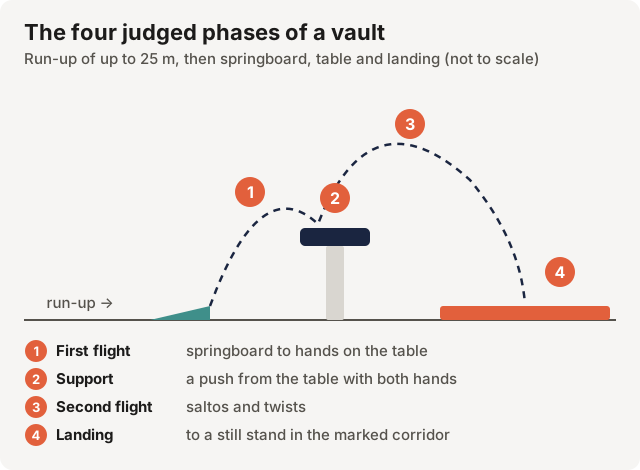
The 2025–2028 WAG Code of Points divides a vault into four phases for judging:
- Pre-flight (first flight) — from the springboard to the hands on the table
- Support — the push from the table, which must use both hands
- Flight (second flight) — the saltos and twists after leaving the table
- Landing — finishing in a stable stand inside a corridor marked on the landing mat
Vault groups
The Code sorts every vault into one of five groups, by how it starts:
- Vaults without a salto (handspring, Yamashita or round-off entries), with or without a twist
- Handspring forward entries, with or without a full turn onto the table, then a salto forward or backward
- Tsukahara entries — a handspring with a quarter or half turn onto the table — then a salto backward
- Yurchenko entries — a round-off onto the board and back handspring onto the table — then a salto backward
- Round-off entries with a half turn onto the table, then a salto forward or backward
Each vault has a number, and the gymnast shows it to the judges before running. For how the families work, see vault numbers and groups, handspring vaults, Tsukahara vaults, round-off entry vaults and the Yurchenko.
How vault is scored
Because every listed vault already has a fixed difficulty value, gymnasts and coaches know the D-score before it is performed — difficulty is not built up element by element as on the other apparatus. If a vault isn’t performed as announced, the judges credit the vault that was actually performed. The E-score is deducted phase by phase: body shape and alignment in the first flight, arm and shoulder position in the support, height, distance and rotation in the second flight, then the landing. Landing or stepping outside the marked corridor is deducted from the final score.
A vault scores zero if, for example, neither hand touches the table, the safety collar isn’t used for a round-off entry, the gymnast doesn’t land feet first, or she performs a prohibited vault such as one with straddled legs.
One vault or two
In qualification, the team final and the all-around final, a gymnast performs one vault. To qualify for the vault final, and in the final itself, she performs two vaults from different groups and the scores are averaged. A 0.20 bonus is added when the two vaults have saltos in different directions — one forward, one backward — and both are landed without a fall.
For the best-known women’s vaults named after gymnasts, see the Produnova and what is a Biles skill?. For the men’s apparatus, see men’s vault.
Sources
- Women's Artistic Gymnastics — 2025-2028 Code of Points — International Gymnastics Federation (FIG) (accessed 31 August 2026)
- FIG Apparatus Norms — International Gymnastics Federation (FIG) (accessed 31 August 2026)
Written by Claire McDonald
Published 25 October 2026 · editorially reviewed 10 October 2026 · High review risk
This page has not been independently reviewed by a gymnastics technical expert.
Spotted an error? Report a correction.